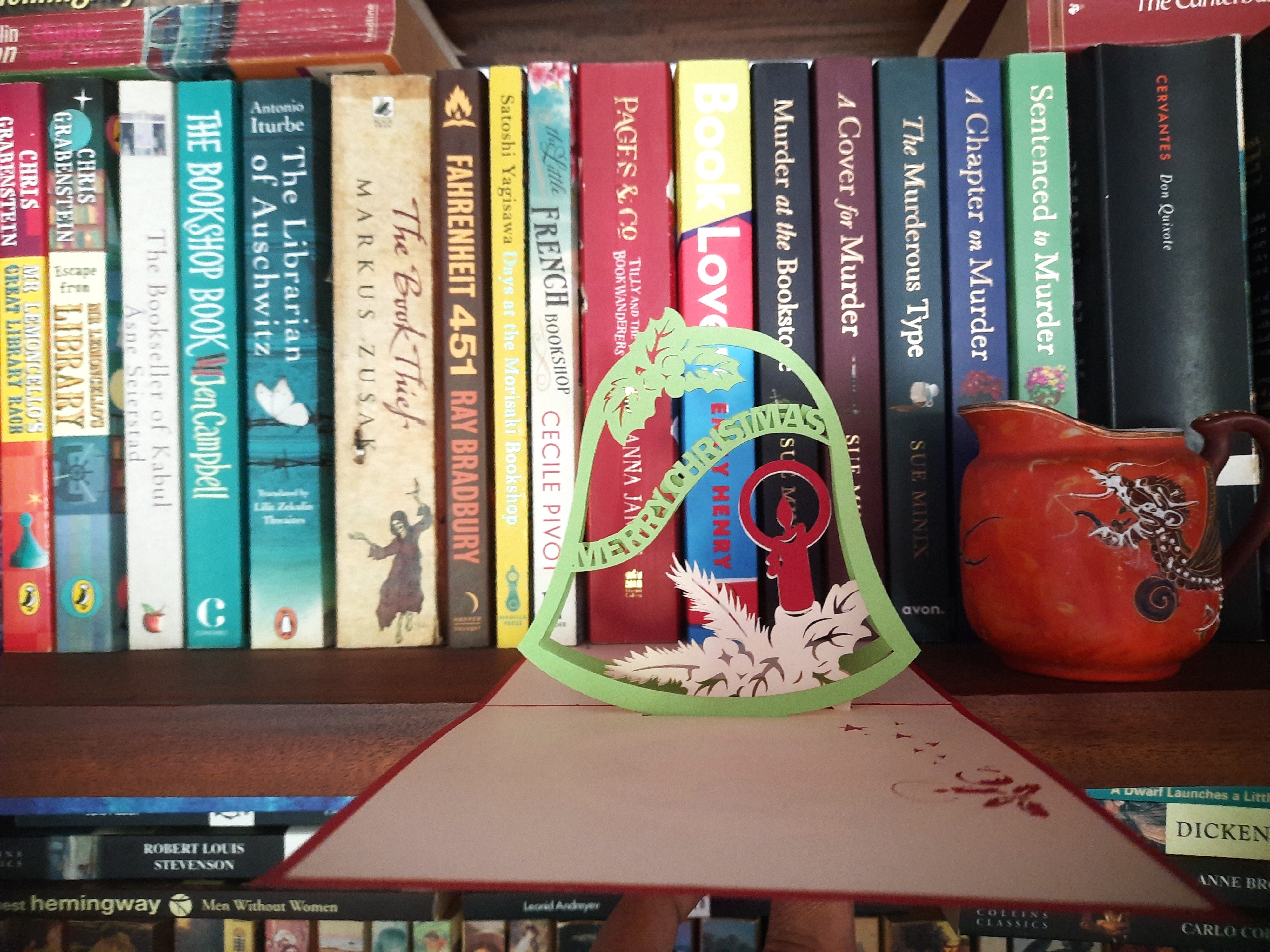
The Old Christmas Card
The circular postage seal belittles the aesthetics of the star-spangled banner on the stamp—the ink is glossier despite the age. Yes, the superpowers tend not to fade too fast! The date of origin of this seal is only partly clear, yet readable: 1993!
Still, my late father, who is the recipient of this Christmas card from the USA, never opened it. It must be a Christmas card because of an illustrated mistletoe on the back of the envelope—and it feels like one too! There is no sender address other than the name Andie on the bottom left corner of the back of the envelope. Though that name always connoted a male in my mind (like Andy Roberts, the West Indian paceman; or Andy Taylor, the guitarist of Duran Duran), my wife told me that the owner of the name is a female.
“Andie, the owner of a lonely heart,” my wife, Indira, sings as she hovers around me like an over-excited kitten. She nudges me to open the card.
The Christmas card is cocooned in a time warp, and ‘Andie’ no longer has any more say in its destiny than its recipient, who is dead, cremated and whose ashes are in a brass urn in one of my book cupboards. His ashes await a river scattering in India, Yamuna river to be specific, after Christmas.
Urn, ashes, cards, and Christmas…for some reason I cannot articulate, I am not ready to open this card.
“Let’s wait for Christmas to open it,” I say with a feigned casual tone.
“Bloody hell—look who’s talking, and you call me starry-eyed,” Indira says. She breaks into fits of laughter. It is a recurring joke in my family that the price I paid for being a ‘realist’ is that I have found an ‘idealist’ wife.
The old Christmas card whispers.
Let me think: my father never opened this card for reasons now hidden from us forever. Do I dare disrupt the intention of those who have left our shores? Isn’t there ethical decorum surrounding the affairs of the dead? On the wings of a swift whim, I decide to keep the card next to the brass urn for the moment—and this just might prevent Indira from opening it without my knowledge.
But things happen extremely fast! As I carefully carry the card to the cupboard, my phone rings: oh dear, office! In the middle of that call, Indira dashes into me with all her soft and slim body—her usual way of grabbing my attention when I am focused on something—to ask for the car key: urgent hair appointment. Next, Janaki, our housekeeper waylays me and complains very loudly that she has no “good” vegetables to cook: for her “good” vegetables are what she buys, not what we buy. I give her extra money and send her off to the market in an incredibly happy mood.
I momentarily forget about the card and when I finally remember, say about 45 minutes later, I simply cannot not find it. Such amnesic episodes aren’t unusual—whenever the mundane stuff hauls my focus I am in-built to disregard an important task at hand. My remedy is to curse myself—which I do with sound and fury since the house is empty. Indira will divorce me for sure, if she hears these execrations. Never mind!
Paranormal events of dead people interfering with the living suddenly crosses my mind. Is this my late father, using an etheric spell to nick the old Christmas card, so I wouldn’t open it? I am almost on the verge of subscribing to that belief when Janaki comes back home with a large bag of fresh-looking vegetables, all bursting and bustling with songs in the rattan bag probably impatient to be cooked; excess sweat on her forehead gives her a glistening sheen, and she sports a victorious smile as she tells me—”Sir, the card on the table, I put it in the post box.”


